MCP
Policy for every MCP tool invocation.
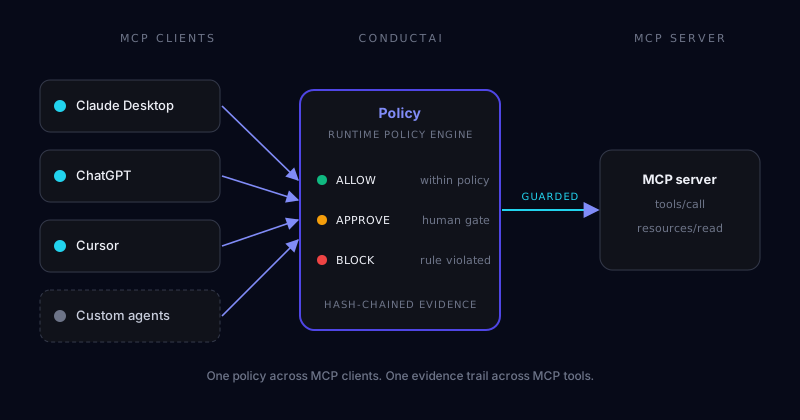
Guard sits between the MCP client and the MCP server. Every tool call is evaluated against policy before it reaches the server — applying runtime policy and evidence-model enforcement across every MCP-compatible client.
Allow. Approve. Block. Prove.
Control before the tool executes.
Guard evaluates the tool call after the model chooses it and before the MCP server receives it. The same policy that governs Claude Code CLI actions also governs MCP tool calls through the same engine.
Wrap the invocation. Keep the server.
Guard adapts the compatible client and MCP server. Your existing MCP servers stay in place — Guard sits at the transport layer, evaluates each tool call, and forwards allowed calls unchanged.
No client changes required
{
  "jsonrpc": "2.0",
  "method": "tools/call",
  "params": {
    "name": "deploy_production",
    "arguments": { "env": "prod" }
  }
}
// guard: APPROVE → routed to Slack
What Guard brings to MCP
MCP transport + OAuth discovery
Conduct exposes MCP over Streamable HTTP at /mcp, with OAuth 2.1 protected-resource discovery at /.well-known/oauth-protected-resource/mcp. Register the URL once; the server advertises capabilities and Guard-wrapped tools per session.
Tool interception and Guard checks
Every tool invocation is intercepted. Guard evaluates it against the workspace policy before forwarding. No client-side configuration required.
OAuth support
Guard supports OAuth for MCP tool authentication. Clients authenticate once; Guard manages token scope and rotation.
Hash-chained evidence
Every MCP tool call decision is recorded in the same audit trail as CLI and proxy decisions. One receipt format across all enforcement surfaces.
Works with any MCP client
If it speaks MCP, Guard wraps it. There is no allow-list of vendors — any client that implements the Model Context Protocol connects through the same discovery endpoint and gets the same policy, audit, and OAuth handling. The clients below are the ones we test on every release.